If you run a stamping, engraving, or embossing line, you’ve probably faced this decision at some point: should you invest in carbide dies, or stick with conventional steel dies? The choice affects your tooling budget, your downtime, and the quality of every part you produce. In this guide, we break down the real differences between carbide dies vs steel dies so you can make the right call for your production volume and application.
What Are Carbide Dies?
Carbide dies are precision tools made from tungsten carbide — a composite material formed by bonding tungsten carbide particles with a metallic binder, usually cobalt. This gives the die exceptional hardness, far beyond what conventional tool steel can offer, along with strong resistance to wear, heat, and repeated mechanical stress.
What Are Steel Dies?
Steel dies are made from hardened tool steel and have been the industry standard for decades. They’re generally more affordable to produce upfront, easier to machine, and well suited to shorter production runs or applications where extreme hardness isn’t the deciding factor.
Carbide Dies vs Steel Dies: Key Differences
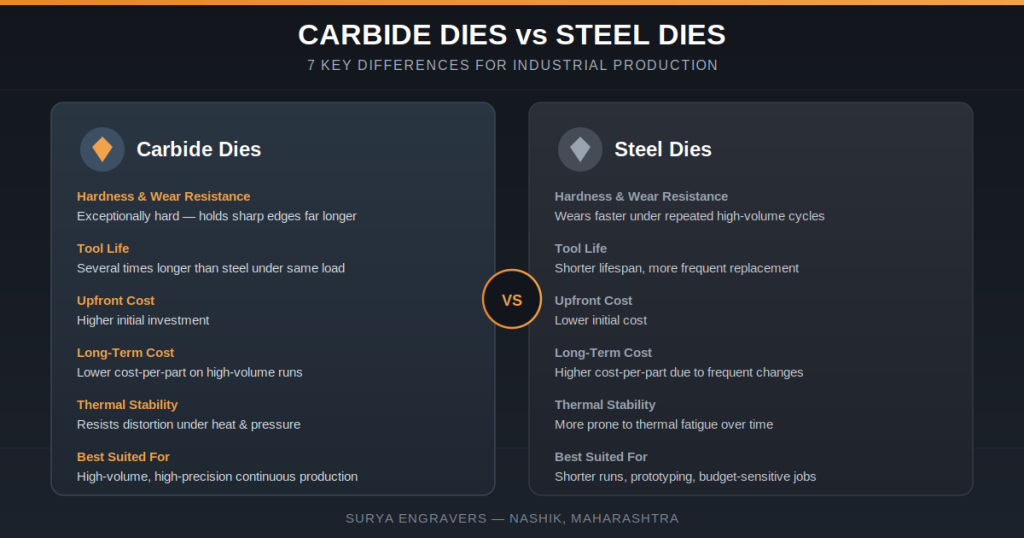
| Factor | Carbide Dies | Steel Dies |
| Hardness & Wear Resistance | Significantly higher — maintains sharp edges far longer | Wears faster under repeated high-volume cycles |
| Tool Life | Typically lasts several times longer than steel under the same load | Shorter lifespan, more frequent replacement |
| Upfront Cost | Higher initial investment | Lower initial cost |
| Long-Term Cost | Lower cost per part over high-volume runs due to fewer replacements | Higher cost per part over time due to frequent tooling changes |
| Heat & Thermal Stability | Resists distortion under heat and pressure, holding tight tolerances | More prone to thermal fatigue and distortion over time |
| Best Suited For | High-volume, high-precision, continuous industrial production | Shorter runs, prototyping, lower-volume or budget-sensitive jobs |
| Machining & Customization | Requires specialized grinding and finishing | Easier and faster to machine or modify |
Which One Should You Choose?
The right choice comes down to your production volume, budget, and tolerance requirements.
Choose carbide dies if: you’re running high-volume production, need tight tolerances maintained over thousands (or millions) of cycles, or want to reduce downtime and replacement frequency. The higher upfront cost is offset by significantly lower cost-per-part over time.
Choose steel dies if: you’re working with shorter production runs, prototyping a new part, or operating under tighter upfront budget constraints where the extended lifespan of carbide isn’t necessary yet.
Many manufacturers actually use a mix of both — steel for prototyping and lower-volume jobs, carbide for the dies running continuous high-volume production.
Why Choose Surya Engravers
At Surya Engravers, we manufacture both carbide and steel dies for industrial stamping, engraving, and embossing applications across Nashik, Maharashtra, and India. Our team helps you evaluate your production volume, material, and tolerance requirements to recommend the right die material — not just sell you the more expensive option. Every die we produce is ground and finished to tight tolerances for consistent, reliable results.
Explore our full range of carbide dies →
Frequently Asked Questions
Do carbide dies really last longer than steel dies?
Yes. Carbide’s superior hardness and wear resistance mean carbide dies typically maintain sharp edges and tight tolerances far longer than conventional steel dies under the same production load, especially in high-volume or abrasive applications.
Are carbide dies worth the extra cost?
For high-volume or continuous production, yes — the reduced downtime, fewer replacements, and consistent part quality usually make carbide dies more cost-effective over the life of the tooling, even though the upfront price is higher.
Can steel dies be upgraded to carbide later?
Not directly — carbide and steel dies are manufactured differently from the start. However, many manufacturers start with steel dies for prototyping and then invest in carbide dies once a part moves into high-volume production.
What industries use carbide dies most?
Carbide dies are common in automotive parts, packaging and printing, sanitary product manufacturing, and any application involving high-cycle stamping, embossing, or engraving where tight tolerances and long tool life matter.