Surya’s carbide dies manufacturer are precision and durability are everything. Whether it is stamping, punching, forming, or drawing metal components, the tool at the heart of every operation is the die. And when it comes to performance, longevity, and accuracy, carbide dies stand in a class of their own.
In this blog, we will explain what carbide dies are, how they are manufactured, where they are used, and why more and more industries in India and across the world are switching to carbide over conventional steel dies.
What Are Carbide Dies?
Carbide dies are precision tooling components made from tungsten carbide — a compound of tungsten and carbon that is extremely hard, wear-resistant, and heat-tolerant. The word “carbide” in manufacturing almost always refers to tungsten carbide (WC), which is one of the hardest materials available for industrial tooling.
These dies are used to cut, shape, stamp, or form materials — particularly metals — with high repeatability and dimensional accuracy. Unlike conventional tool steel dies, carbide dies can withstand far greater pressures and temperatures without deforming or wearing out.
Key fact: Tungsten carbide is approximately 3 times stiffer than steel and has a hardness of around 9 on the Mohs scale (diamond is 10). This is what makes carbide dies ideal for high-volume, high-precision production environments.
How Are Carbide Dies Made?
The manufacturing of carbide dies involves a multi-step process that combines advanced materials science with CNC precision machining.
Step 1 — Powder Preparation
Tungsten carbide powder is mixed with a binder metal — usually cobalt (Co) — in precise ratios. The cobalt content typically ranges from 3% to 25% depending on the required hardness vs toughness balance. More cobalt = tougher but slightly softer. Less cobalt = harder but more brittle.
Step 2 — Pressing / Compaction
The powder mixture is pressed into the approximate shape of the die using hydraulic or isostatic pressing methods. At this stage, the part is called a “green compact” — it has shape but no strength yet.
Step 3 — Sintering
The green compact is placed in a high-temperature furnace and sintered at approximately 1,400°C to 1,600°C. During sintering, the cobalt melts and binds the tungsten carbide grains together, resulting in an extremely dense and hard solid block.
Step 4 — CNC Grinding & EDM Machining
After sintering, the carbide blank is machined to its final dimensions using CNC grinding machines and Electrical Discharge Machining (EDM). Since sintered carbide is too hard to cut with standard tools, diamond-tipped grinding wheels and EDM wire cutting are used to achieve tolerances as tight as ±0.005 mm.
Step 5 — Polishing & Quality Inspection
The finished die is polished to a mirror finish and inspected using CMM (Coordinate Measuring Machine) or optical comparators. Every carbide die from Surya Engravers is quality-checked before dispatch to ensure dimensional accuracy and surface quality.
Types of Carbide Dies
- Carbide Stamping Dies: Used in high-speed stamping presses to cut or form sheet metal parts. Widely used in automotive, electronics, and appliance manufacturing.
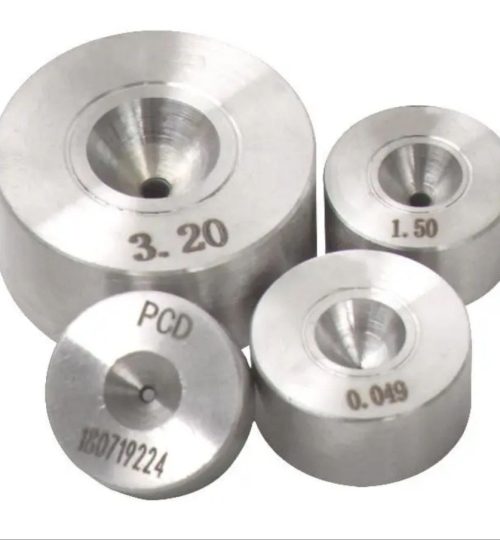
- Carbide Drawing Dies: Used to draw metal wire or rods through a die hole to reduce their diameter. Essential in wire manufacturing plants.
- Carbide Punching Dies: Used to punch holes or cutouts in sheet metal with extreme precision and minimal burring.
- Carbide Coining Dies: Used to produce coins, medals, and precision-coined metal components where fine surface details are required.
- Carbide Profile Dies: Custom-shaped dies for forming complex profiles and cross-sections in extrusion or rolling operations.
- Carbide Progressive Dies: Multi-stage dies used in progressive stamping presses to perform multiple operations in a single stroke.
Key Uses of Carbide Dies Across Industries
- Automotive Industry: Carbide stamping dies are used to produce engine components, brackets, connectors, and body parts in large volumes. The wear resistance of carbide ensures millions of parts can be produced before the die needs replacement.
- Electronics & Electrical Industry: Precision punching and forming dies made from carbide are used to manufacture terminals, connectors, lead frames, and contact springs.
- Wire & Cable Industry: Carbide wire drawing dies are used to reduce thick wire rods into fine gauge wires used in cables, springs, and fasteners.
- Packaging Industry: Carbide cutting and embossing dies are used to cut packaging materials and create clean, precise edges in high-speed packaging lines.
- Pharmaceutical Industry: Carbide tablet punching dies are used in pharmaceutical tablet press machines to produce pills with precise shape, weight, and surface finish.
- Fastener & Hardware Industry: Carbide heading and thread rolling dies are used to manufacture bolts, screws, nuts, and rivets with high dimensional accuracy.
- Jewellery & Coin Manufacturing: Carbide coining dies are used to strike coins, medals, and jewellery components with fine surface detail and consistent dimensions.
Benefits of Carbide Dies Over Steel Dies
- Exceptional Hardness & Wear Resistance: Carbide dies last 20x to 100x longer than steel dies in many applications. This dramatically reduces tooling replacement frequency and production downtime.
- High Dimensional Accuracy: Carbide maintains its shape under pressure far better than steel, ensuring consistent part dimensions over millions of production cycles.
- Better Surface Finish on Parts: The hardness of carbide allows polishing to a much finer surface finish, which translates to better quality output — especially important in wire drawing and coining.
- Heat & Corrosion Resistance: Carbide dies perform reliably at elevated temperatures and resist oxidation and corrosion, making them suitable for demanding production environments.
- Lower Long-Term Cost: Although carbide dies cost more upfront, their extended service life results in significantly lower cost per part — a strong economic advantage for high-volume manufacturers.
- Suitable for Hard Materials: Carbide dies can stamp, punch, and form hardened steel, stainless steel, titanium, and other difficult-to-process materials that would quickly wear out conventional steel tooling.
Carbide Dies vs Steel Dies: Quick Comparison
| Feature | Carbide Dies | Steel Dies |
| Hardness | Extremely High (HRA 88–93) | Moderate (HRC 58–65) |
| Wear Resistance | Excellent — 20x–100x longer life | Wears faster under heavy loads |
| Initial Cost | Higher | Lower |
| Cost Per Part | Lower (longer life) | Higher (frequent replacement) |
| Surface Finish | Mirror-level possible | Limited |
| Best For | High volume, hard materials | Low volume, softer materials |
How to Choose the Right Carbide Die for Your Application
When selecting a carbide die, consider the following:
- Material being processed (mild steel, stainless steel, copper, aluminium, etc.)
- Production volume — high volume justifies carbide; low volume may suit steel
- Required dimensional tolerance and surface finish
- Type of operation — stamping, drawing, punching, coining, or forming
- Operating conditions — temperature, lubrication, press speed
- Cobalt content — lower cobalt for harder applications; higher cobalt for tougher/impact applications
At Surya Engravers, we work closely with our clients to understand their application and recommend the most suitable carbide grade, die geometry, and finish for their specific needs.
Carbide Dies by Surya Engravers, Nashik
Surya Engravers is a leading carbide dies manufacturer based in Nashik, Maharashtra, with over 10 years of experience in precision die manufacturing and CNC engraving. We serve clients across Nashik, Pune, Mumbai, Aurangabad, and pan-India.
Our carbide dies are manufactured using state-of-the-art CNC engraving machines and EDM equipment, ensuring tight tolerances and superior surface quality. We manufacture custom carbide dies as per client drawings, samples, or specifications — with fast turnaround times and competitive pricing.
We manufacture:
- Carbide Stamping Dies
- Carbide Punches
- Carbide Progressive Dies
- Carbide Profile Dies
- Carbide Coining Dies
- Carbide Drawing Dies
- Custom Carbide Tooling as per Drawing
Conclusion
Carbide dies are the backbone of modern precision manufacturing. Their unmatched hardness, wear resistance, and dimensional accuracy make them the preferred choice for industries where quality, consistency, and productivity cannot be compromised.
Whether you are in the automotive, electronics, packaging, wire, or pharmaceutical industry — investing in high-quality carbide dies is a decision that pays for itself many times over through reduced downtime, consistent output quality, and lower cost per part.
If you are looking for a reliable carbide dies manufacturer in Nashik, contact Surya Engravers today. We offer custom carbide tooling solutions tailored to your exact requirements.
📞 +91 9511212105 / +91 7798783035
📧 suryaengraver@gmail.com
🌐 www.suryaengraver.com
📍 Plot No. 18/P/9, MIDC Satpur, Nashik, Maharashtra
Q: How long do carbide dies last?
A: Carbide dies can last 20 to 100 times longer than steel dies, depending on the application, material being processed, and operating conditions.
Q: What is the difference between carbide dies and steel dies?
A: Carbide dies are harder, more wear-resistant, and maintain dimensional accuracy over far longer production runs. Steel dies are cheaper upfront but wear faster and are better suited for low-volume applications.
Q: Can carbide dies be repaired?
A: Yes, in many cases worn carbide dies can be reground or reconditioned to restore their dimensions, extending their useful service life.
Q: Where can I buy carbide dies in Nashik?
A: Surya Engravers manufactures custom carbide dies in Nashik, Maharashtra. Contact us at +91 9511212105 for specifications and pricing.