If you manufacture coins, medallions, badges, or precision-embossed metal components, the quality of your coining dies decides everything — the sharpness of detail, the consistency across thousands of pieces, and how long your tooling lasts before it needs replacement. Yet most buyers searching for a coining dies manufacturer in India don’t know what actually separates a reliable supplier from an average one.
This guide covers everything you need to know — what coining dies are, how they’re made, the materials that matter, and a practical checklist for choosing the right manufacturer.
What Are Coining Dies?
Coining dies are precision-engineered tooling used to impress a design, pattern, or text onto a metal blank under extremely high pressure — without cutting or removing material. Unlike stamping, which often shears or cuts metal, coining compresses it into a die cavity, producing crisp, high-relief detail on both sides of the piece.
Coining dies are used to manufacture:
- Coins and currency-style tokens
- Medallions and commemorative pieces
- Metal badges and emblems
- Branded metal tags and nameplates
- Precision embossed components for industrial use
How Coining Dies Work: The Coining Process
- Design & Engraving – The design is first engraved into a hardened die block using CNC engraving machines for micron-level accuracy.
- Die Hardening – The die undergoes heat treatment to withstand repeated high-pressure impact without deforming.
- Coining Press Operation – A blank is placed between the male and female die halves and struck under high tonnage, forcing the metal to flow into every detail of the die cavity.
- Finishing – The finished piece is deburred, polished, or plated depending on the application.
Because coining relies on metal flow rather than cutting, die precision is non-negotiable — even a small flaw in the die will replicate itself on every single piece produced.
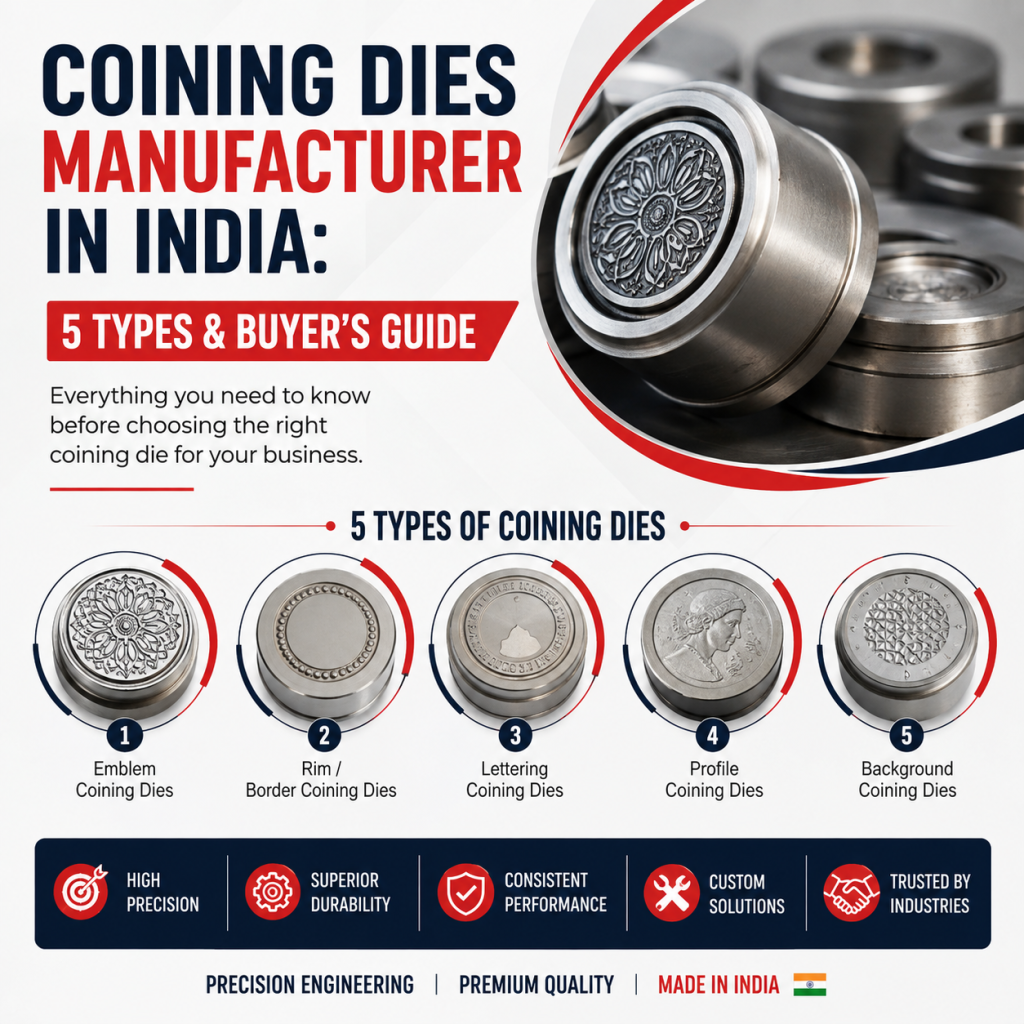
Types of Coining Dies
- Single-Impression Coining Dies — used for simple, one-sided designs.
- Double-Sided (Obverse & Reverse) Coining Dies — used for coins and medallions with detail on both faces.
- Progressive Coining Dies — combine coining with blanking and forming in a single die set for high-volume production. (See our detailed guide on Progressive Dies if you’re evaluating this route.)
Materials Used in Coining Die Manufacturing
The right material depends on production volume and the hardness of the metal being coined:
- Hardened Tool Steel — the industry standard; balances toughness with wear resistance for medium-to-high volume runs.
- Carbide — used when extreme wear resistance and tighter tolerances are needed for very high-volume or abrasive-material production. Our Carbide Dies page covers this in more depth.
- Cast Iron / Aluminum — occasionally used for prototype or low-volume dies where cost matters more than die life.
Coining Dies vs Embossing Dies: What’s the Difference?
This is one of the most common points of confusion for buyers. Coining uses very high pressure to fully compress metal into a die cavity for deep, sharp, coin-like relief — while embossing typically raises a pattern on thinner material with comparatively lower pressure, often for decorative or packaging use. If you’re unsure which process fits your product, our Embossing Dies guide breaks down the distinction further.
Applications of Coining Dies Across Industries
- Mints and numismatic/collectible coin production
- Corporate and defense medallions
- Automotive branding tags and nameplates
- Jewelry and decorative metal components
- Promotional and award badges
How to Choose the Right Coining Dies Manufacturer in India
Use this checklist before finalizing a supplier:
- CNC engraving capability — Ask whether designs are engraved using 3-axis/4-axis CNC machines for consistent micron-level accuracy across every die.
- Material expertise — Confirm they work with hardened tool steel and carbide, not just soft metals.
- Sample/prototype process — A manufacturer should be able to produce a test impression before committing to full production tooling.
- Turnaround time — Custom die manufacturing typically takes days, not weeks, with an experienced team.
- Track record — Look for manufacturers with a demonstrated history across multiple industries, not just one product type.
- After-sales support — Die wear is inevitable over high-volume runs; check if the manufacturer offers repair, re-engraving, or replacement support.
Why Choose Surya Engravers for Coining Dies
Surya Engravers has been delivering precision CNC engraving and die manufacturing solutions since 2015, serving clients across Nashik, Pune, Mumbai, and pan-India. We manufacture coining dies using advanced CNC engraving technology and premium-grade tool steel and carbide, ensuring sharp detailing, excellent repeatability, and long-lasting durability — even for high-volume production runs.
Frequently Asked Questions
Q1: What is the lifespan of a coining die?
A well-made hardened steel coining die can produce anywhere from tens of thousands to several hundred thousand impressions before requiring re-engraving, depending on material hardness and production volume.
Q2: Can coining dies be used for both metal coins and industrial components?
Yes. The same coining principle applies whether you’re producing currency-style tokens or precision-embossed industrial nameplates — the die design simply changes based on the application.
Q3: How long does it take to manufacture a custom coining die?
Turnaround typically depends on design complexity, but an experienced manufacturer with in-house CNC engraving can usually deliver custom coining dies within a matter of days.
Q4: What’s the difference between coining dies and stamping dies?
Stamping often involves cutting, bending, or shearing metal, while coining compresses metal into a die cavity without removing material — producing deeper, more detailed relief. See our Stamping Dies vs Progressive Dies comparison for more on stamping-specific processes.
Ready to Get Your Coining Dies Manufactured?
Whether you need dies for coins, medallions, badges, or precision industrial components, Surya Engravers combines CNC precision with over a decade of die-manufacturing experience to deliver dies that perform consistently, run after run.
Contact Surya Engravers today for a custom coining dies quote, or call +91 9511212105 / +91 7798783035 to discuss your requirement directly.