Packaging is no longer just about protecting a product. It is also one of the first things customers notice when they see a product on a shelf, in a store, or online.
A well-designed package can attract attention, communicate brand quality and make a product feel more premium. This is where premium packaging finishes become important.
Techniques such as embossing, foil stamping, debossing and 3D effects can transform an ordinary printed box, carton, label or paperboard package into something more attractive and memorable.
But which packaging finish should you choose? What is the difference between embossing and foiling? How does 3D embossing work? And what role do dies and foiling blocks play in the final result?
This guide explains the most popular premium packaging finishing techniques in simple language and helps you understand where each technique can be used.
What Are Premium Packaging Finishes?
Premium packaging finishes are additional processes applied to printed packaging to improve its appearance, texture, depth, shine or overall visual appeal.
Traditional printing mainly adds colour, images and text to a surface. Finishing techniques can add another dimension by changing how the packaging looks and feels.
Some common packaging finishing techniques include:
- Embossing
- Debossing
- Hot foil stamping
- Foil embossing
- 3D or multi-level embossing
- Texture embossing
- Spot UV
- Matte and gloss finishes
- Special laminations
Among these, embossing and foiling are particularly popular for premium and luxury packaging because they can highlight important elements such as logos, product names, patterns and decorative details.
The right finish depends on the packaging material, artwork, desired appearance, production quantity and budget.
Why Are Premium Packaging Finishes Important?
Imagine two product boxes placed next to each other.
One has a standard printed design.
The other has a clean logo with a raised texture, metallic gold details and a subtle 3D effect.
The second package is more likely to attract attention because it provides both a visual and tactile experience.
Premium finishing can help packaging:
1.Create a Premium Appearance
Gold, silver and other metallic foils can give packaging a luxurious appearance, while embossing can add depth and texture.
This is commonly useful for products positioned as premium or luxury products.
2. Make Branding More Noticeable
A brand logo does not always need to be large to attract attention.
A small embossed or foil-stamped logo can become a strong focal point on a package.
3. Add a Tactile Experience
Embossing allows customers to actually feel the design.
The raised surface can make a logo, pattern or text more distinctive than ordinary flat printing.
4. Create Shelf Impact
In competitive retail categories, packaging needs to stand out among many similar products.
Combining appropriate finishes can help create a stronger visual identity.
5. Improve Perceived Product Value
Finishing techniques do not automatically make a product better, but carefully designed packaging can influence how customers perceive the product and brand.
Research and packaging-industry guidance also emphasize the role of tactile and visual finishing in creating premium packaging experiences.
What Is Embossing in Packaging?
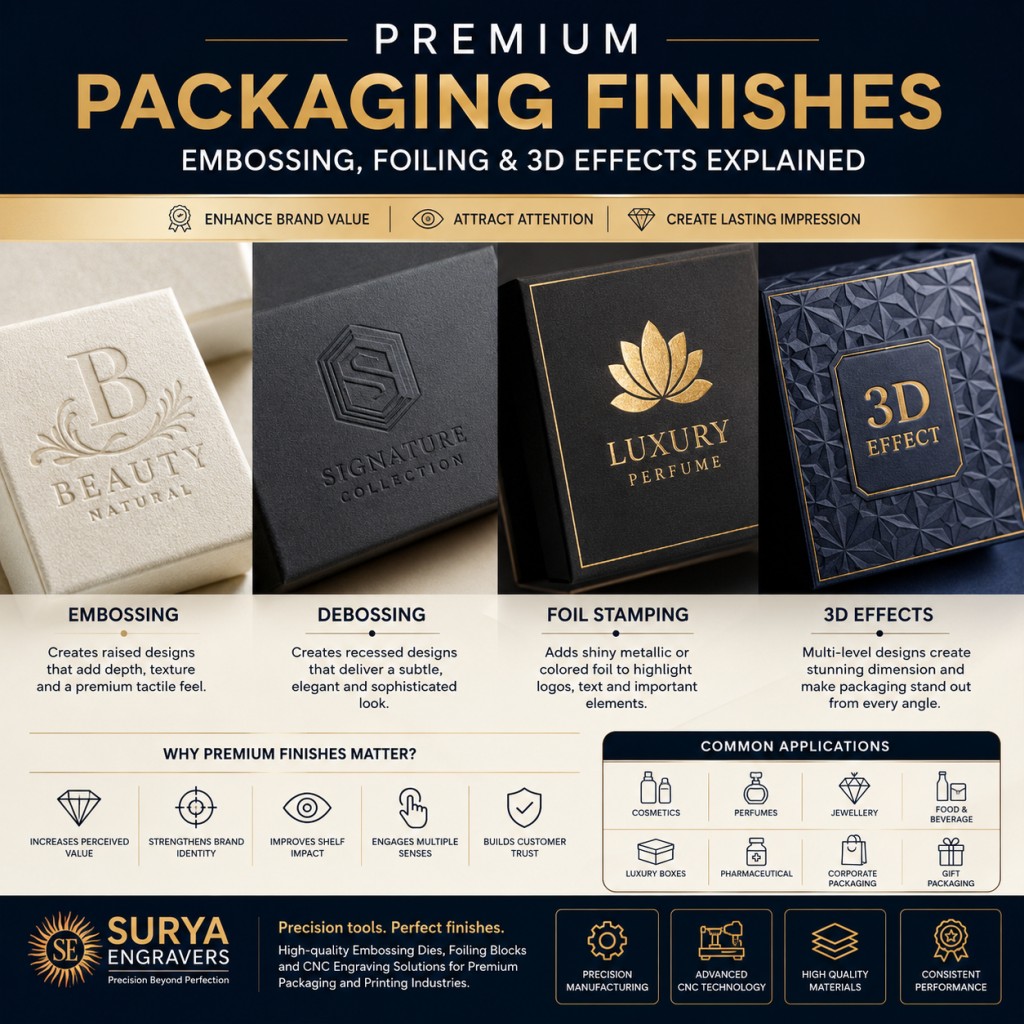
Embossing is a packaging finishing technique that creates a raised design on the surface of a material.
A custom embossing die applies controlled pressure to the packaging material to create the desired raised shape.
The result can be seen from different angles and can also be felt by touching the surface.
Embossing can be used for:
- Brand logos
- Product names
- Decorative patterns
- Borders
- Symbols
- Illustrations
- Textures
- Premium design elements
Depending on the design and tooling, embossing can create anything from a subtle raised logo to a highly detailed three-dimensional effect.
How Does Embossing Work?
The basic embossing process involves creating a custom die according to the approved artwork.
The packaging material is positioned correctly and pressure is applied through the die to form the design.
For more complex embossing applications, matched male and female tooling may be used to create controlled relief and depth. The final result depends on factors such as artwork, material, die design, pressure and registration.
A simplified process looks like this:
Artwork → Die Design → Die Manufacturing → Die Setup → Embossing → Quality Inspection
The quality of the embossing die is therefore an important part of achieving a clean and consistent result.
What Is Debossing?
Debossing is essentially the opposite of embossing.
Instead of raising the design above the packaging surface, debossing presses the design into the material.
Embossing:
Design is raised.
Debossing:
Design is recessed.
Debossing can create an elegant, subtle appearance and is often used for logos, patterns and premium branding.
Both techniques can also be combined with other finishing processes depending on the desired packaging design.
What Is Foil Stamping in Packaging?
Foil stamping, also called hot foil stamping, is a finishing technique used to transfer a thin layer of foil onto a packaging surface using heat and pressure.
Gold and silver are common choices, but packaging applications can also use other metallic, coloured and specialty foils.
The process typically involves a specially manufactured foiling block or stamping die containing the required design.
When heat and pressure are applied, the selected foil is transferred onto the packaging surface.
The result can create:
- Metallic logos
- Product names
- Decorative borders
- Metallic patterns
- Premium typography
- Brand elements
Foiling is particularly effective when a designer wants to add shine and contrast to a packaging design.
Embossing vs Foiling: What Is the Difference?
This is one of the most common questions when planning premium packaging.
| Feature | Embossing | Foil Stamping |
| Main effect | Raised / 3D | Metallic or coloured |
| Main benefit | Texture and depth | Shine and visual contrast |
| Can be felt? | Yes | Usually less tactile |
| Requires tooling? | Yes | Yes |
| Common applications | Logos, patterns, premium boxes | Logos, text, decorative elements |
| Typical visual effect | Relief | Metallic finish |
| Can be combined? | Yes | Yes |
The two techniques are not necessarily competitors.
In fact, embossing and foiling can be combined to create a stronger premium effect.
What Is Foil Embossing?
Foil embossing combines the visual effect of foil stamping with the raised effect of embossing.
Instead of having a flat metallic logo, the logo can be raised from the packaging surface while also receiving a metallic foil finish.
This creates three noticeable elements:
Colour + Shine + Dimension
For example, imagine a luxury cosmetic box with a raised gold brand logo.
The gold foil provides the shine.
The embossing provides the raised surface.
The combination creates a more dimensional appearance than flat foil alone.
Foil embossing is commonly associated with premium packaging where brands want both metallic impact and tactile depth.
What Are 3D Packaging Effects?
3D packaging effects are finishing techniques that create a stronger sense of depth, dimension and texture.
Traditional flat printing represents an image on a two-dimensional surface.
3D finishing changes the physical surface itself.
Some examples include:
- Multi-level embossing
- Sculptured embossing
- Deep embossing
- Textured embossing
- Foil embossing
- Combination embossing and foiling
The exact appearance depends on the artwork and the die design.
For example, a simple logo may use a single-level emboss, while a detailed illustration may require multiple levels and carefully designed tooling.
What Is Multi-Level Embossing?
Multi-level embossing creates different heights within a single design.
Instead of having one uniform raised level, different sections of the artwork can have different depths.
This can make a design appear more sculpted.
It can be useful for:
- Detailed logos
- Product illustrations
- Decorative patterns
- Luxury boxes
- Premium labels
- High-end presentation packaging
Multi-level and sculptured embossing are among the techniques used when packaging requires more detailed dimensional effects.
What Is Texture Embossing?
Texture embossing creates a specific surface pattern rather than simply raising a logo.
For example, a package can be designed with textures inspired by:
- Leather
- Fabric
- Wood
- Geometric patterns
- Natural surfaces
- Decorative motifs
Texture can be used across a larger area of packaging or selectively around a logo or design element.
This is particularly useful when the packaging concept depends heavily on the tactile experience.
Which Products Commonly Use Premium Packaging Finishes?
Premium packaging finishes can be used across many industries.
Cosmetics and Beauty Products
Luxury cosmetic boxes often use combinations such as:
- Gold foil
- Silver foil
- Embossed logos
- Matte surfaces
- Spot UV
- Soft-touch finishes
Jewellery Packaging
Jewellery boxes and presentation packaging can benefit from subtle embossing and metallic foil to communicate a premium brand identity.
Perfume and Fragrance Packaging
Perfume cartons frequently use embossed logos, foil stamping and dimensional effects to create a sophisticated appearance.
Food and Beverage Packaging
Premium chocolates, specialty foods, confectionery and beverage packaging can use embossing and foiling to differentiate products on retail shelves.
Gift Packaging
Premium gift boxes and corporate gift packaging can use embossed branding, foil logos and decorative textures.
Pharmaceutical and Healthcare Packaging
Certain pharmaceutical and healthcare packaging applications can also use specialised finishing techniques for branding, identification or design purposes, depending on the packaging requirements.
How to Choose the Right Packaging Finish?
Choosing a packaging finish should not be based only on what looks attractive.
The finish needs to work with the material, artwork, production process and intended result.
Consider these factors before selecting a finishing technique.
1. Packaging Material
Different papers, boards, laminates and substrates respond differently to pressure, heat and finishing processes.
Always consider the material before finalising the die and finishing method.
2. Artwork Complexity
A simple logo may work well with standard embossing or foil stamping.
Highly detailed artwork may require specialised tooling and careful preparation.
3. Desired Appearance
Ask what you want the packaging to communicate.
Do you want:
- Shine?
- Texture?
- Depth?
- A metallic appearance?
- A subtle premium effect?
- A strong 3D effect?
The answer will help determine the most suitable technique.
4. Production Quantity
Tooling and finishing decisions should also consider the expected production volume.
For large production runs, investing in durable and accurately manufactured tooling can be particularly important.
5. Budget
Combining several finishing techniques can increase production complexity and cost.
A carefully selected single finish can sometimes create a better result than using too many effects at once.
6. Registration Requirements
If embossing or foiling needs to align precisely with printed artwork, accurate registration becomes very important.
Artwork, die design and production setup should therefore be planned together.
Embossing and Foiling: Can They Be Used Together?
Yes.
In fact, combining embossing and foiling is one of the most effective ways to create a premium packaging effect.
For example:
Matte packaging + embossed logo + gold foil
can create a strong contrast between the soft background and the shiny, raised logo.
Another option is:
Dark packaging + silver foil + subtle embossing
which can create a modern and sophisticated appearance.
The important point is not to use every possible finish simply because it is available.
The best packaging designs use finishing techniques strategically.
What Is an Embossing Die?
An embossing die is a custom tool used to create a raised or recessed design on packaging or other materials.
The die is manufactured according to the approved artwork and the required embossing effect.
The quality and precision of the die can directly affect:
- Design clarity
- Embossing depth
- Edge definition
- Detail reproduction
- Consistency
- Overall finish quality
For complex packaging designs, die design becomes particularly important.
What Is a Foiling Block?
A foiling block is a specially manufactured tooling component used to transfer foil onto a substrate during the foil stamping process.
The block contains the design that needs to be transferred.
Depending on the application, tooling may be manufactured from different materials and according to the required production and finishing specifications.
A properly designed foiling block helps achieve clean:
- Logos
- Text
- Lines
- Patterns
- Decorative elements
For packaging manufacturers and printers, selecting the right foiling block is therefore an important part of achieving consistent foil stamping results.
Why Die Quality Matters in Premium Packaging
The final packaging effect is only as good as the tooling and production process behind it.
A poorly designed or manufactured die can result in:
- Uneven embossing
- Loss of fine details
- Inconsistent depth
- Poor registration
- Damaged packaging material
- Inconsistent production results
Precision manufacturing becomes particularly important when the design contains fine lettering, detailed logos, multiple levels or complex patterns.
This is where CNC machining and precision engraving can play an important role in producing accurate packaging dies and tooling.
How CNC Engraving Supports Premium Packaging
Modern CNC engraving technology can be used to manufacture precision tooling for applications where accurate reproduction of the artwork is required.
A simplified tooling workflow can include:
Artwork/CAD Design → CNC Programming → Precision Engraving → Finishing → Inspection → Final Tool
CNC technology can help manufacturers achieve repeatable and detailed tooling for different packaging applications.
For packaging manufacturers, the goal is not simply to create a die. The goal is to create tooling that can reproduce the required design consistently during production.
Common Mistakes to Avoid in Premium Packaging Finishing
Using Too Many Effects
More effects do not always mean better packaging.
Combining embossing, multiple foils, UV, textures and other finishes without a clear design strategy can make packaging look crowded.
Ignoring the Packaging Material
A finish that works well on one substrate may not produce the same result on another.
Using Extremely Fine Artwork Without Testing
Very fine lines and small details may require careful die design and production testing.
Not Considering Registration
If foil or embossing needs to align with printed artwork, even small registration errors can affect the final appearance.
Choosing Tooling Only on Initial Cost
The cheapest tooling option is not always the most suitable for a high-volume or high-detail application.
The correct choice should consider the design, expected production volume, material and required finish.
How to Create a Premium Packaging Finish: Step-by-Step
A successful packaging finishing project generally starts well before the actual embossing or foiling machine is used.
Step 1: Finalise the Packaging Design
Determine which areas require printing, embossing, foiling or other effects.
Step 2: Select the Material
Choose the appropriate paper, board, laminate or substrate.
Step 3: Prepare the Artwork
The artwork should clearly identify the areas requiring special finishing.
Step 4: Select the Finishing Technique
Decide whether the design requires embossing, debossing, foil stamping, foil embossing, 3D embossing or a combination.
Step 5: Manufacture the Tooling
The required embossing die, foiling block or other tooling is manufactured according to the approved design.
Step 6: Test the Finish
A sample or trial can help identify issues with depth, registration, foil transfer or material response before full production.
Step 7: Begin Production
Once the tooling and process are approved, the packaging can move into production.
Step 8: Inspect the Final Result
The finished packaging should be checked for consistency, clarity, alignment and overall appearance.
Which Packaging Finish Should You Choose?
Here is a simple way to decide:
Want a raised design?
→ Choose Embossing
Want an indented design?
→ Choose Debossing
Want a shiny metallic logo?
→ Choose Foil Stamping
Want a raised metallic logo?
→ Choose Foil Embossing
Want different levels of depth?
→ Consider Multi-Level or 3D Embossing
Want a tactile surface pattern?
→ Consider Texture Embossing
Want maximum visual impact?
→ Consider a carefully planned combination of embossing and foiling
The right choice ultimately depends on the packaging material, artwork, production requirements and desired brand appearance.
Why Work With a Precision Die Manufacturer?
Premium packaging finishes depend heavily on accurate tooling.
Whether the application requires an embossing die, foiling block or another custom tool, the manufacturer needs to understand the artwork, material and production requirements.
A precision die manufacturer can help with:
- Custom tooling
- Detailed die design
- CNC engraving
- Embossing dies
- Foiling blocks
- Complex packaging designs
- Repeatable production tooling
For packaging manufacturers, printers and brands, working with an experienced tooling partner can make the transition from artwork to finished packaging more predictable.
Premium Packaging Finishes with Surya Engravers
Surya Engravers provides precision tooling solutions for printing, packaging and industrial applications, including embossing dies, foiling blocks and CNC engraving services.
For packaging applications, accurately manufactured tooling can help reproduce logos, text, patterns and other design elements with the required level of precision.
If you are developing premium packaging and need custom embossing dies, foiling blocks or precision CNC engraving, Surya Engravers can help you select and develop tooling according to your application requirements.
The right packaging finish starts with the right design—and the right tooling helps turn that design into a consistent finished product.
Frequently Asked Questions About Premium Packaging Finishes
What are premium packaging finishes?
Premium packaging finishes are special processes used to improve the appearance, texture, depth or visual impact of packaging. Common examples include embossing, debossing, foil stamping and 3D effects.
What is the difference between embossing and foiling?
Embossing creates a raised or dimensional effect on the packaging surface, while foiling transfers a metallic or coloured foil onto the surface. The two techniques can also be combined.
What is 3D embossing?
3D embossing creates a more pronounced dimensional effect by using different levels of depth within the design. It can be used for detailed logos, illustrations and premium packaging.
What is a foiling block?
A foiling block is a custom tooling component containing the design used to transfer foil onto a packaging surface during foil stamping.
What is an embossing die?
An embossing die is a precision tool used to create raised or recessed designs on packaging materials.
Can embossing and foil stamping be combined?
Yes. Foil stamping and embossing can be combined to create a raised metallic design, often called foil embossing.
Which packaging products use embossing?
Embossing is commonly used on luxury boxes, cosmetic packaging, perfume packaging, jewellery packaging, premium cartons, labels, presentation boxes and other branded packaging.
How do I choose the right packaging finish?
Consider the packaging material, artwork complexity, desired appearance, production quantity, budget and required level of detail. Sampling before large-scale production can also help confirm the final effect.
Does the quality of the embossing die affect the final packaging?
Yes. Die design and manufacturing precision can influence the clarity, depth, detail and consistency of the embossing result.
Final Thoughts
Premium packaging is about more than adding decorative effects. The most effective packaging finishes are selected to support the brand, product and overall packaging design.
Embossing adds texture and depth.
Foiling adds shine and visual contrast.
3D and multi-level effects add dimension.
And when these techniques are combined thoughtfully, they can turn ordinary packaging into a much more distinctive brand experience.
For manufacturers and printers looking for reliable packaging tooling, the process begins with accurate artwork, suitable materials and precision-manufactured embossing dies and foiling blocks.
With the right combination of design, finishing technique and tooling, premium packaging can create a stronger visual and tactile impression while maintaining consistency throughout production.