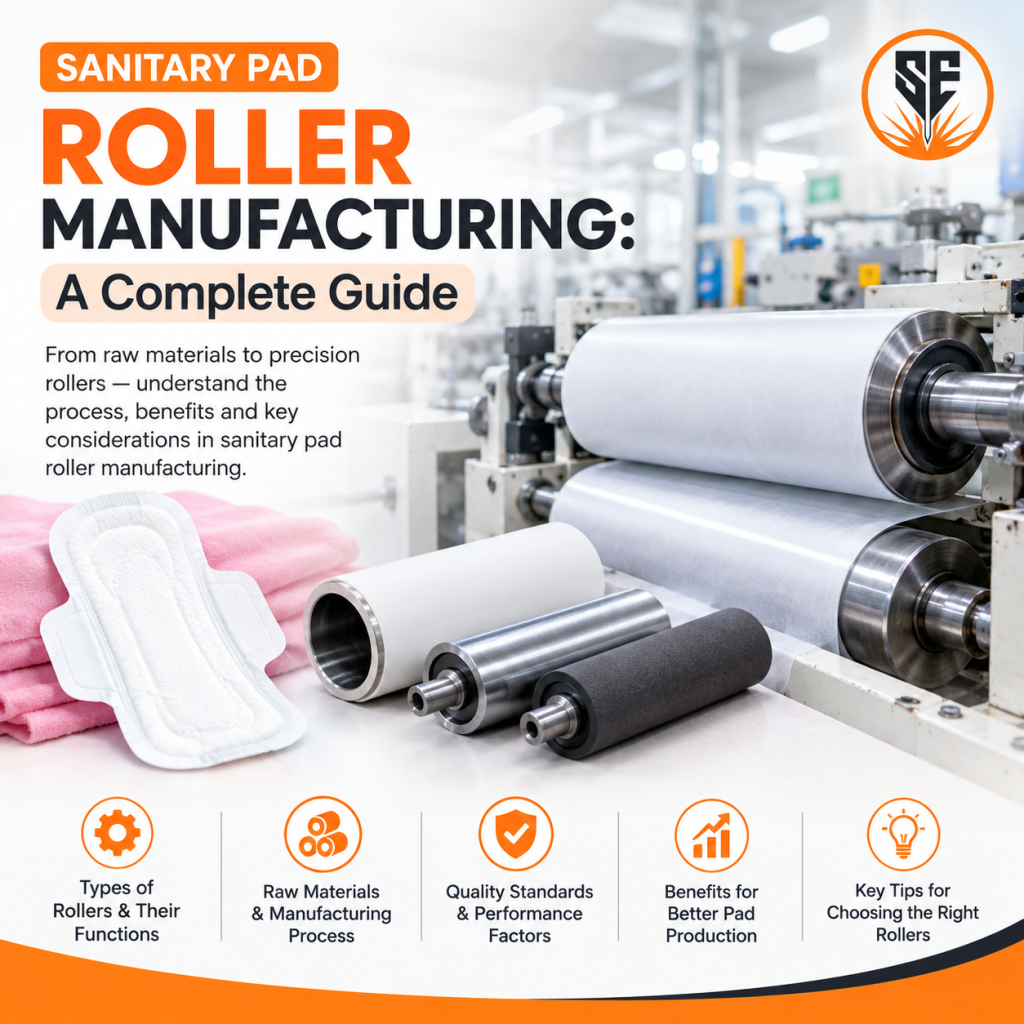
A sanitary pad roller manufacturer plays a bigger role in your production quality than most people realize — the roller inside your machine quietly decides the shape, embossing, and finish of every single pad you produce. A precise, well-engineered roller gives each pad its consistent shape, its embossed channels, and its clean, wrinkle-free finish. Get the roller wrong, and you deal with scrap, downtime, and inconsistent output. Get it right, and your line runs faster, cleaner, and more profitably.
In this guide, we’ll break down what a sanitary pad roller actually is, the different types used across a production line, how they’re manufactured, and what to check before choosing a supplier.
What Is a Sanitary Pad Roller?
A sanitary pad roller is a specialized, high-precision steel roller used in the manufacturing of sanitary napkins, pads, and similar hygiene products. As the raw material layers — non-woven fabric, absorbent core, film, and adhesive — pass through the pad-making machine, these rollers shape, emboss, mold, and cut the material into its final form.
Every finished pad you see on a store shelf has passed through several of these rollers, each performing a specific job in the production sequence.
Types of Sanitary Pad Rollers
1. Embossing Rollers
These rollers press fine patterns and channels into the top sheet and absorbent core. The embossed pattern isn’t just cosmetic — it directs fluid toward the center of the pad and helps prevent leakage from the sides. Getting the depth and pattern geometry right directly affects how well the pad performs.
2. Cutting Rollers
Cutting rollers shape each pad to its exact outline, including wing cut-outs and edge contours. Precision here determines whether pads come out with clean, consistent edges at high production speeds.
3. Molding Rollers
Used to shape and bond multiple material layers together, ensuring the core, top sheet, and back sheet form a single, well-bonded structure without wrinkles or gaps.
Most production lines use a combination of these rollers working in sync, so consistency across the full set matters as much as the quality of any single roller.
How Sanitary Pad Rollers Are Manufactured
Material Selection
Rollers are typically machined from hardened alloy steel, chosen for its ability to withstand continuous pressure, friction, and heat without losing dimensional accuracy over time.
CNC Engraving & Precision Machining
The embossing patterns, cutting profiles, and molding contours are cut using CNC engraving and precision machining processes — the same core technology every reliable sanitary pad roller manufacturer relies on for consistent output. This is where accuracy really counts — even minor deviations in groove depth or pattern spacing can show up as visible defects in the finished pad.The embossing patterns, cutting profiles, and molding contours are cut using CNC engraving and precision machining processes. This is where accuracy really counts — even minor deviations in groove depth or pattern spacing can show up as visible defects in the finished pad.
Hardening & Surface Treatment
After machining, rollers go through hardening and surface finishing to improve wear resistance and corrosion resistance. This step extends the roller’s working life under continuous high-speed operation.
Balancing & Precision Testing
Before dispatch, rollers are checked for run-out, dimensional accuracy, and surface finish. A poorly balanced roller causes vibration on the machine, which shows up as inconsistent embossing or misaligned cuts on the final product.
What to Check Before Choosing a Sanitary Pad Roller Manufacturer
- Engraving precision: Ask for sample patterns or reference work — pattern accuracy is the single biggest factor in embossing quality.
- Material & hardening process: Confirm the steel grade and hardening treatment used, especially if your line runs continuously at high speed.
- Customization capability: If you need a specific embossing pattern, branding, or channel design, your supplier should be able to translate your design into an accurate engraved roller.
- Turnaround time: Roller wear is inevitable — a supplier who can deliver replacements or repairs quickly minimizes your production downtime.
- Track record with hygiene products: Manufacturing tolerances for hygiene product rollers are tighter than many general industrial applications — experience in this specific niche matters.
Why Choose Surya Engravers for Sanitary Pad Rollers
At Surya Engravers, we manufacture precision sanitary pad rollers using advanced CNC engraving technology, built for the accuracy and durability that continuous hygiene-product production lines demand. Our team works closely with clients to translate exact embossing patterns, cutting profiles, and custom branding requirements into rollers that perform reliably at production speed — with the sharp detailing and long service life your line needs.
Frequently Asked Questions
1. What material does a sanitary pad roller manufacturer use to make these rollers?
A sanitary pad roller manufacturer typically machines these rollers from hardened alloy steel, chosen for its strength, wear resistance, and ability to hold precise dimensions under continuous high-speed operation.
2. How long does a sanitary pad roller last?
Roller life depends on production speed, material hardness, and maintenance, but a well-manufactured, properly hardened roller can run for an extended production period before requiring re-engraving or replacement.
3. Can the embossing pattern be customized?
Yes. Embossing patterns — including absorption channels, brand logos, and decorative finishes — can be custom-engraved based on your design requirements.
4. What’s the difference between an embossing roller and a cutting roller?
An embossing roller presses patterns and channels into the material for shape and fluid control, while a cutting roller shapes the pad’s final outline, including edges and wing cut-outs.
5. Do you work as a sanitary pad roller manufacturer for both new machines and replacements?
Yes, as a sanitary pad roller manufacturer we build rollers for new production lines as well as replacement and re-engraving requirements for existing machines.
6. What industries use sanitary pad rollers besides sanitary napkins?
The same roller technology is used for similar hygiene and non-woven products, including adult diapers, baby diapers, and other absorbent hygiene items with comparable production processes.
Get a Quote for Your Sanitary Pad Roller
Need a precision-engineered sanitary pad roller for your production line? As an experienced sanitary pad roller manufacturer, Surya Engravers builds custom embossing, cutting, and molding rollers made for accuracy and long-term performance.
Call us at +91 9511212105 / +91 7798783035 or get a quote here to discuss your requirements.