If you work in sheet metal fabrication, you’ve almost certainly used a part that started life as a blank cut by a blanking die. Blanking is one of the most fundamental operations in metal stamping — and choosing the right blanking dies manufacturer in India directly affects your part accuracy, tool life, and production cost.
At Surya Engravers, we design and manufacture precision blanking dies for automotive, electrical, packaging, and general engineering industries across India. In this guide, we’ll cover what blanking dies are, how the process works, the main types, and how a good blanking dies manufacturer in India should support your production.
What Are Blanking Dies?
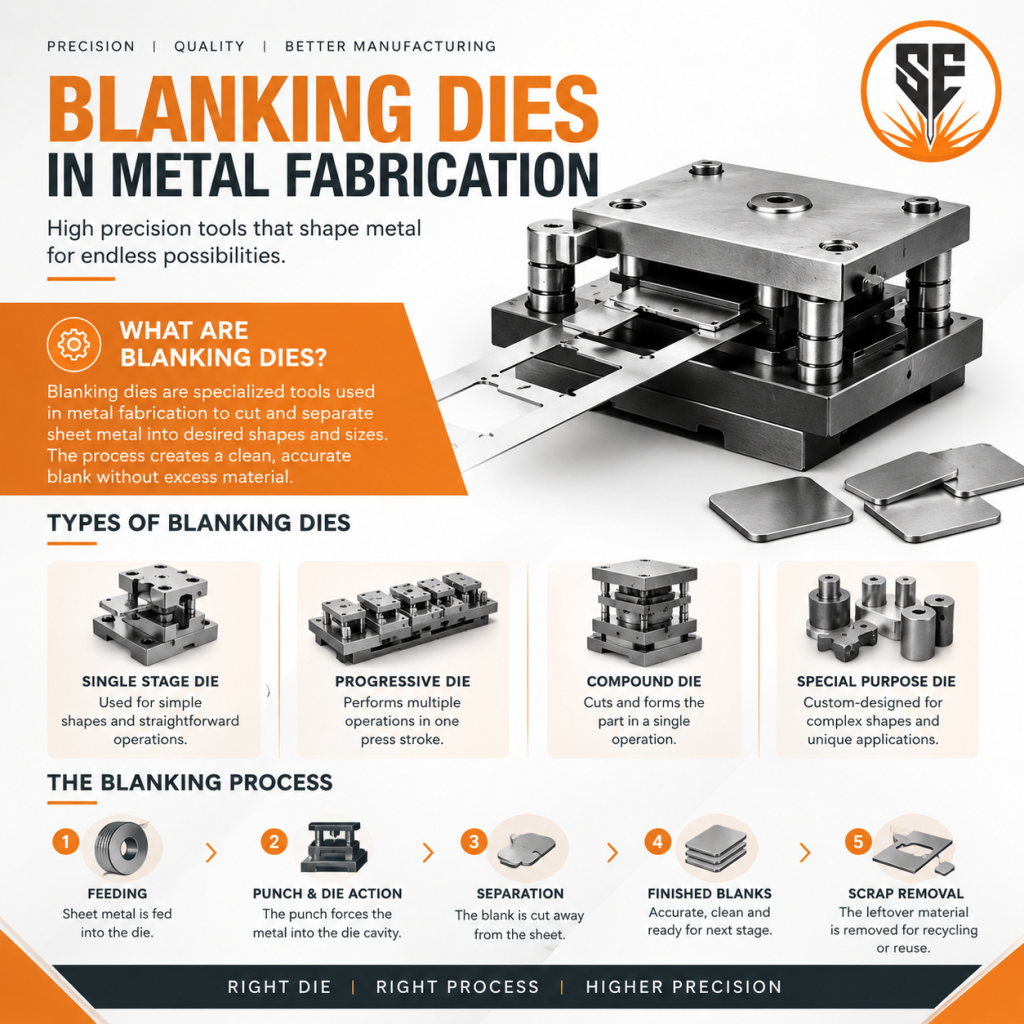
A blanking die is a tool used in a press to cut a flat piece of metal — called a “blank” — out of a larger sheet in a single stroke. Unlike punching (where the hole is the waste and the surrounding metal is the product), in blanking, the cut-out piece itself is the finished part.
The cut piece also often becomes the starting material for further forming. (See Wikipedia’s overview of blanking in sheet metal work for the underlying mechanics.)
Blanking dies consist of two main components:
- Punch — the male part that pushes down through the sheet
- Die (or die block) — the female part with a matching cavity that the punch shears against
The clearance between punch and die is critical — even a fraction of a millimeter off affects edge quality, burr formation, and die life.
How the Blanking Process Works
- Sheet Metal Feeding — Coil or sheet stock is fed into the press, either manually or via a coil feeder for high-volume runs.
- Positioning — The material is aligned using pilots or stops to ensure consistent blank placement.
- Punching Stroke — The press ram drives the punch down through the sheet into the die cavity, shearing the blank free.
- Blank Ejection — The cut blank drops through the die or is ejected, while the remaining strip (skeleton) continues through the press or is scrapped.
- Progressive Integration — In high-volume production, blanking is often the first station in a progressive die, followed by bending, piercing, or forming stations.
Tight punch-die clearance (typically 5–10% of material thickness) is what separates a clean, burr-free blank from a rough, unusable one.
Types of Blanking Dies
A capable blanking dies manufacturer in India typically offers all five of these die types, each suited to a different production need:
1. Conventional (Simple) Blanking Dies
Used for low-to-medium volume production of single, simple-shaped blanks. Cost-effective for prototype runs and short production cycles.
2. Compound Blanking Dies
Perform blanking and piercing (or another operation) in a single stroke at one station, improving accuracy and reducing cycle time — ideal for parts needing both an outer profile and internal holes.
3. Progressive Blanking Dies
Blanking is one station among several in a progressive die strip, allowing blanking, piercing, and forming to happen in sequence as the strip advances — used for high-volume, complex parts. This is a common setup among any established blanking dies manufacturer in India serving the automotive sector.
4. Fine Blanking Dies
A specialized process using a V-ring pressure pad and counter-punch to produce blanks with extremely smooth, perpendicular edges and tight tolerances — common in automotive and precision electronics components where secondary machining needs to be eliminated.
5. Steel Rule Blanking Dies
Uses hardened steel strips set into a wooden or plywood base instead of a solid die block. Cost-effective for low-volume runs, prototyping, and softer materials like gaskets, rubber, and thin cardboard.
Applications of Blanking Dies
Any experienced blanking dies manufacturer in India will tell you these parts show up everywhere, across almost every sheet metal-driven industry:
- Automotive — brackets, washers, chassis components, battery plates
- Electrical & Electronics — connector plates, lamination stacks, terminal blanks
- Packaging — metal closures, can components, container blanks
- General Engineering — washers, gaskets, spacer plates, flat brackets
Blanking is often the very first step before a part goes through bending, deep drawing, or embossing — which is why blank accuracy at this stage matters so much for downstream operations.
Blanking Dies vs. Piercing Dies
Since blanking and piercing are often confused, here’s how a blanking dies manufacturer in India distinguishes the two:
| Aspect | Blanking Dies | Piercing Dies |
| What’s used | The cut-out piece | The remaining sheet (hole is waste) |
| Typical use | Producing the finished blank | Creating holes/openings in a part |
| Common combo | Often paired with piercing in compound dies | Often paired with blanking in compound dies |
Why Choose Surya Engravers as Your Blanking Dies Manufacturer
- Precision tooling — tight punch-die clearances for clean, burr-minimal blanks
- Custom die design — simple, compound, progressive, or fine blanking dies built to your part spec
- Material expertise — dies built for mild steel, stainless steel, aluminum, copper, and specialty alloys
- Nashik-based manufacturing — fast turnaround and direct client communication across Maharashtra and pan-India
- End-to-end support — from die design and CNC machining to trial runs and production support, the same way we support our carbide dies and coining dies clients
As a full-service blanking dies manufacturer in India, we handle everything from a single prototype die to a complete progressive tool.
We support high-volume production the same way we support our carbide dies and coining dies clients.
FAQs
Q1. What is the difference between blanking and punching?
In blanking, the cut-out piece is the useful part. In punching, the cut-out piece is scrap and the remaining sheet is the useful part.
Q2. What materials can blanking dies work with?
Blanking dies can process mild steel, stainless steel, aluminum, brass, copper, and various specialty alloys, depending on die material and hardness.
Q3. How long do blanking dies manufacturer in india last?
Tool life depends on die material, part complexity, and material being blanked — hardened tool steel dies can last from tens of thousands to millions of strokes with proper maintenance.
Q4. Is fine blanking more expensive than conventional blanking?
Yes, fine blanking dies cost more upfront due to the specialized pressure-pad tooling, but they eliminate secondary finishing operations, often reducing total part cost for precision applications.
Q5. Can Surya Engravers design custom blanking dies?
Yes — we design and manufacture custom blanking dies based on your part drawings, material specification, and production volume.
Conclusion
Blanking dies are the foundation of most sheet metal production lines — get the die design and clearance right, and everything downstream (forming, piercing, assembly) becomes easier and more consistent. Blanking dies are the foundation of most sheet metal production lines — get the die design and clearance right, and everything downstream (forming, piercing, assembly) becomes easier and more consistent. That’s exactly what you should expect from any blanking dies manufacturer in India you choose to work with. If you’re looking for a dependable blanking dies manufacturer in India, Surya Engravers combines precision engineering with fast turnaround to keep your production running smoothly.
Ready to get a quote for your blanking die requirement? [Contact Surya Engravers today.]