Every sheet metal component with a hole, slot or cut-out started its life inside a punching die. Brackets, electrical panels, automotive parts, washers and enclosures all depend on it. If you are choosing a punching dies manufacturer in India, you need to understand how these dies work, which type suits your part, and what design details decide die life and hole quality.
This guide covers everything buyers and production engineers usually search for: what punching and piercing dies are, the 7 main types, how they work, materials, clearance, design tips, common defects and how to select the right supplier.
What Are Punching Dies?
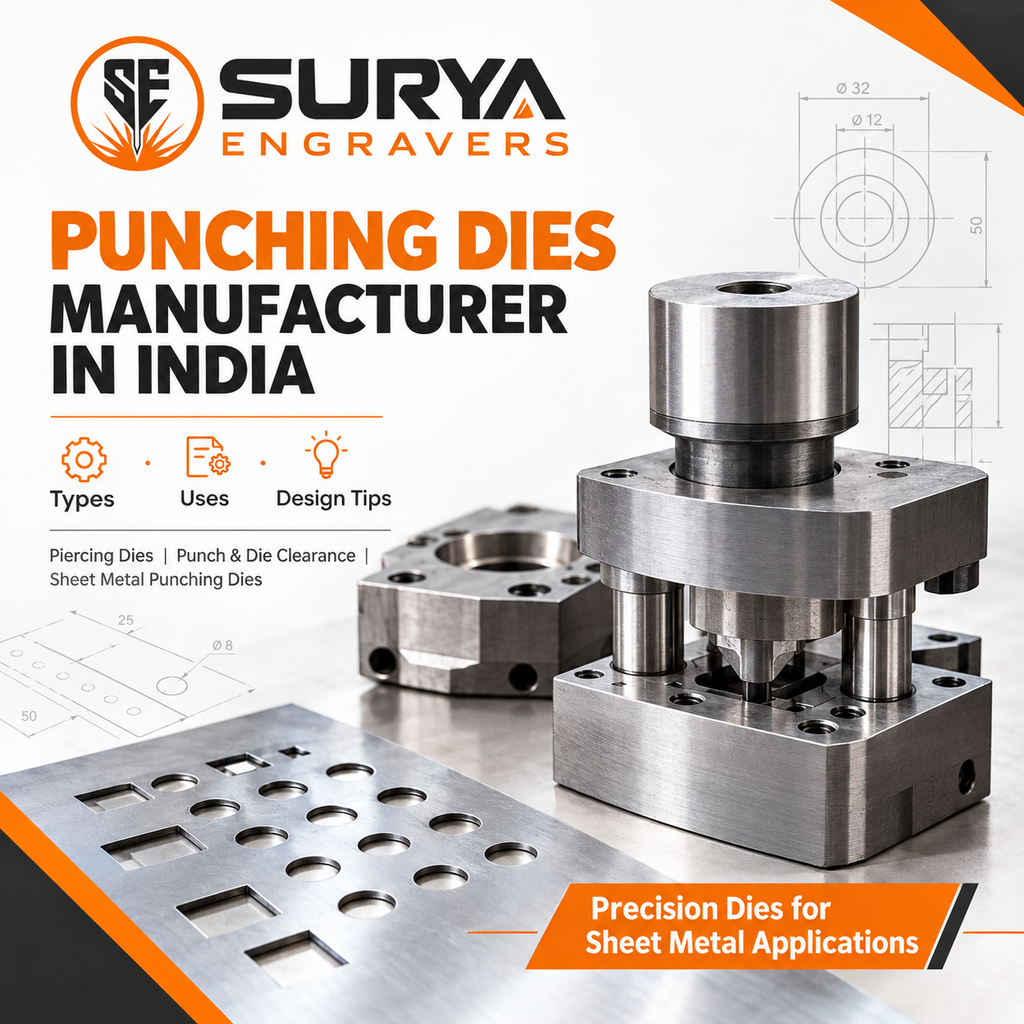
- Punch: the male part that moves down and pushes through the sheet.
- Die (die block): the female part with a matching opening that supports the sheet and shears the metal cleanly.
When the press closes, the punch forces the material into the die opening. The metal fractures along the cutting edges, and a small piece of scrap called a slug drops out. What remains is a precisely cut hole.
What Are Piercing Dies?
Piercing dies work on the same shearing principle. The term “piercing” is commonly used when the die makes holes in a part that is already formed, bent or drawn, or when the hole is the important feature of the component. In everyday shop-floor language, “punching” and “piercing” are often used interchangeably.
The difference to remember is the purpose:
- In punching, the slug is scrap and the sheet with the hole is the product.
- In blanking, the slug is the product and the remaining sheet is scrap.
If you need blanked components, see our detailed guide on [Blanking Dies Manufacturer in India: Types, Process & Applications].
7 Types of Punching and Piercing Dies
1. Simple (Single-Station) Punching Die
This die performs one operation per press stroke, such as punching one hole or a group of holes. It has a simple construction and low tooling cost, which makes it ideal for prototypes, low volumes and basic components.
2. Compound Punching Die
A compound die performs two or more operations, usually blanking and piercing, in one press stroke at a single station. Because all features are cut together, hole-to-edge accuracy and flatness are excellent. It suits washers, gaskets and flat precision parts.
3. Progressive Punching Die
In a progressive die, the strip moves through several stations. Each station performs one operation such as piercing, notching, bending or cut-off, and a finished part comes out with every stroke. It is the best choice for high-volume production. Read more in our guide on [Progressive Dies: How They Work, Types & Why Industries Prefer Them] (add internal link).
4. Perforating Die
A perforating die punches a large number of small holes in a single stroke. It is used for filters, speaker grills, ventilation panels, sieves and decorative sheets. These dies need very accurate punch alignment and strong stripper plates because small punches are fragile.
5. Notching Die
A notching die removes material from the edge of the sheet or strip. It is used to prepare parts for bending, to create tabs, or to form corner reliefs before forming.
6. Cam (Side) Piercing Die
When holes are required on the side walls of a formed or drawn part, a cam mechanism converts the vertical press motion into horizontal punch movement. This type is common in automotive parts, cylindrical housings and formed brackets.
7. Carbide-Insert Punching Die
For abrasive materials, thin stainless steel, silicon steel laminations or very high production runs, carbide punches and die inserts give much longer life than tool steel. If you are unsure whether to choose carbide or steel, read [Carbide Dies vs Steel Dies: Which One Lasts Longer in Industrial Production?]
Quick Comparison: Which Punching Die Should You Choose?
| Die Type | Best For | Production Volume | Tooling Cost |
| Simple Die | Basic holes, prototypes | Low | Low |
| Compound Die | Flat, accurate parts (washers, gaskets) | Low to medium | Medium |
| Progressive Die | Complex parts with many operations | High | High |
| Perforating Die | Multiple small holes, grills, filters | Medium to high | Medium to high |
| Notching Die | Edge cuts, tabs, relief cuts | Any | Low to medium |
| Cam Piercing Die | Side holes on formed parts | Medium to high | High |
| Carbide-Insert Die | Abrasive or long-run jobs | Very high | High (lowest cost per part) |
For a deeper comparison, see [Stamping Dies vs Progressive Dies: Which One Does Your Production Need?]
Where Are Punching and Piercing Dies Used?
Punching dies are used in almost every manufacturing sector:
- Automotive: brackets, clips, chassis parts, heat shields
- Electrical and electronics: switchgear panels, terminals, busbars, motor laminations
- Packaging: metal caps, closures and containers
- Appliances: washing machine drums, cooker parts, fan guards
- Construction hardware: hinges, brackets, fasteners, perforated sheets
- Engineering and fabrication: enclosures, machine guards, mounting plates
Materials Used to Make Punching Dies
The material you choose directly affects tool life, cost and performance.
- D2 tool steel (high carbon, high chromium): the most popular choice for punches and die blocks. It offers high wear resistance and good hardness after heat treatment.
- A2 / air-hardening steels: good toughness and dimensional stability, suited to medium runs.
- HCHCr and OHNS steels: economical options for simple, lower-volume tools.
- Tungsten carbide: highest wear resistance for long production runs and abrasive materials.
- Mild steel or C45: used for die sets, backing plates and holders, not for cutting components.
Cutting parts are normally heat-treated and ground to reach the required hardness before final finishing.
Key Design Tips for Punching Dies
1. Get the Punch-to-Die Clearance Right
Clearance is the gap between the punch and the die opening. As a general guide, clearance is set as a percentage of the sheet thickness per side, and it varies with material type and hardness. Too little clearance increases punching force, causes secondary shear and wears the tool quickly. Too much clearance creates large burrs and rollover. Always confirm the exact figure for your material with your die designer.
2. Calculate Punching Force (Tonnage) Correctly
Punching force depends on the cut perimeter, the material thickness and the shear strength of the material. Underestimating the tonnage overloads the press, and overestimating it wastes cost. Angled or stepped punch faces (shear on the punch) can reduce the peak force on large cut-outs.
3. Keep Hole Size and Thickness in Proportion
As a thumb rule, a punched hole should not be smaller than the material thickness. Very small holes in thick sheet can break punches. When tiny holes are unavoidable, use guided and stripper-supported punches.
4. Maintain Safe Distance Between Holes and Edges
Holes placed too close to each other or to the sheet edge cause bulging and distortion. Keep enough web between features so the metal does not tear or deform.
5. Use a Proper Stripper System
When the punch retracts, the sheet tends to lift with it. A spring-loaded or fixed stripper holds the sheet down and prevents buckling, jamming and punch damage.
6. Plan Slug Disposal
Slugs that rise back up onto the die surface (slug pulling) can damage both the tool and the part. Use vacuum-relief holes in the punch, proper die-opening relief and correct clearance to keep slug pulling under control.
7. Ensure Precise Alignment and Guiding
Use quality die sets with hardened guide pillars and bushes. Even a small misalignment causes uneven clearance, burrs and early wear.
8. Choose Machining Methods Carefully
Modern punching dies are made with CNC machining, wire EDM, surface grinding and jig grinding. Accurate machining and finishing give clean cutting edges and repeatable results from the first stroke to the millionth.
Common Punching Die Problems and How to Fix Them
- Excessive burrs: usually caused by worn cutting edges or wrong clearance. Regrind the tools or correct the clearance.
- Slug pulling: caused by vacuum or oil on the slug. Add slug-retention features or relief.
- Punch breakage: caused by misalignment, hole too small for material thickness or lack of guiding. Improve guiding and support.
- Distorted or bulged sheet: caused by weak stripping or holes too close together. Improve stripper force and spacing.
- Rapid wear: caused by abrasive material or low-grade tool steel. Upgrade to D2 with proper heat treatment or carbide inserts.
How to Extend the Life of Your Punching Die
- Sharpen (regrind) punches and dies at the right interval rather than waiting for heavy burrs.
- Lubricate the sheet properly during production.
- Inspect stripper springs, guide bushes and fasteners regularly.
- Store dies clean, oiled and protected from rust.
- Keep a record of stroke counts for every die.
How to Choose the Right Punching Dies Manufacturer in India
The die you buy is only as good as the company that builds it. Before you place an order, check these points:
- Design capability: does the manufacturer study your drawing and suggest improvements?
- Machinery: CNC machining, wire EDM and grinding capability in-house.
- Material and heat-treatment quality: proper tool steel grades and controlled hardening.
- Tryout and trial support: the die should be tried on a press before dispatch.
- Lead time and after-sales service: regrinding, spare punches and repair support.
- Experience across die types: compound, progressive, blanking and coining.
For a complete checklist, read [How to Choose the Right Die Manufacturer in India: 7 Things to Check]
Custom Punching and Piercing Dies by Surya Engravers, Nashik
At Surya Engravers, we design and manufacture custom dies and tooling for industrial use, backed by CNC machining and precision finishing. Whether you need a simple punching die, a compound tool or a full progressive die, our team works from your drawing or sample and helps you pick the right die type for your production volume.
Frequently Asked Questions (FAQs)
1. What is the difference between punching and piercing dies?
Both cut holes using shearing action. Punching usually refers to making holes in flat sheet, while piercing often refers to making holes in formed parts or where the hole itself is the critical feature. In practice, many people use the two terms interchangeably.
2. What is the difference between punching and blanking?
In punching, the removed slug is scrap and the sheet with the hole is the product. In blanking, the removed piece is the product and the remaining sheet is scrap.
3. Which material is best for punching dies?
D2 tool steel is the most common choice because of its wear resistance and hardness. For very high volumes or abrasive sheet materials, tungsten carbide inserts last much longer.
4. What is punch-to-die clearance?
It is the gap between the punch and the die opening on each side. It is set as a percentage of the sheet thickness and depends on the material. The right clearance gives clean edges, lower force and longer tool life.
5. How do I calculate punching force?
Punching force is calculated by multiplying the cut perimeter by the sheet thickness and the shear strength of the material. Add a safety margin when selecting the press capacity.
6. How long does a punching die last?
Life depends on material, sheet thickness, die steel, heat treatment and maintenance. A well-made tool steel die can produce a very large number of parts between regrinds, and carbide dies last longer still.
7. What causes burrs on punched holes?
Burrs are mainly caused by worn cutting edges or incorrect clearance. Regular regrinding and correct clearance control burrs.
8. Can punching dies be used for stainless steel and aluminium?
Yes. Stainless steel needs harder tooling and tighter control because it work-hardens, while aluminium needs polished surfaces and correct clearance to avoid galling.
9. Should I choose a progressive die or a simple punching die?
Choose a simple or compound die for low volumes and flat parts. Choose a progressive die when you need high volumes and multiple operations in one pass.
10. How do I find a good punching dies manufacturer in India?
Look for in-house CNC and wire EDM capability, strong design support, quality tool steel, press tryout facilities and reliable after-sales service.
Conclusion
Punching and piercing dies look simple, but the right type, material, clearance and design make a big difference to part quality and cost per piece. Match the die to your production volume and part complexity, and work with a manufacturer who understands both design and machining.
If you need custom tooling, reach out to Surya Engravers in Nashik and let our team help you build the right die for your application.